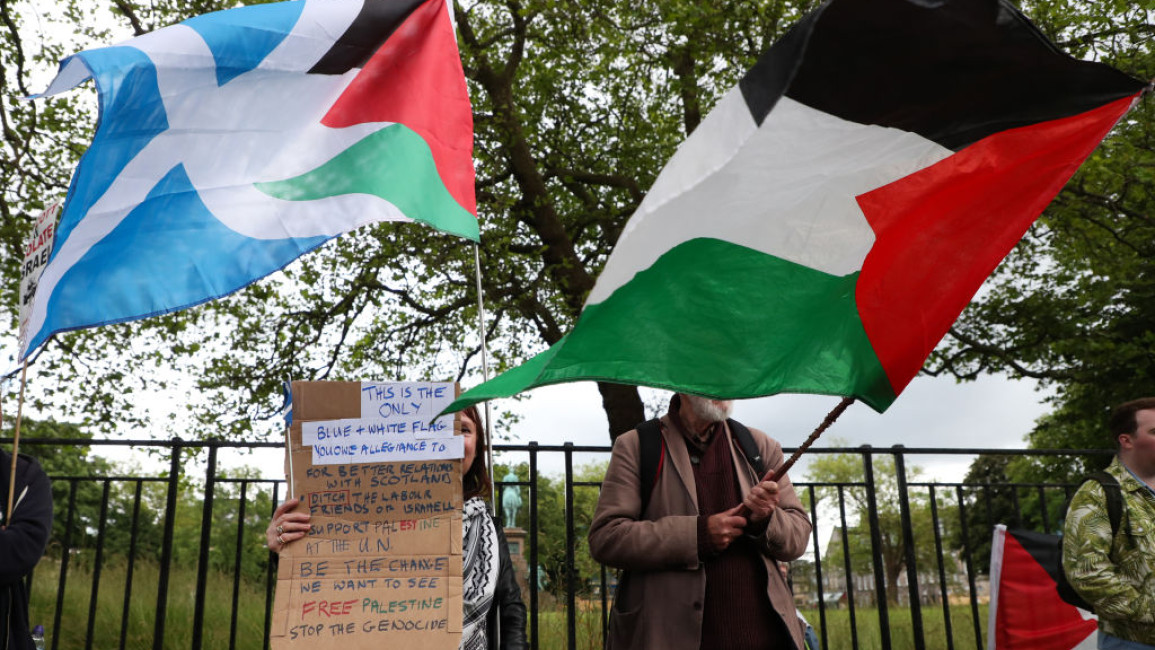
In September 2025, the Scottish Parliament made history by endorsing a comprehensive package of Boycott, Divestment, and Sanctions (BDS) against Israel – the first national parliament to do so. Yet, as the May 2026 elections approach, there are growing fears that this landmark victory is being allowed to fade into a ‘symbolic’ gesture rather than becoming the catalyst for tangible change it was promised to be.
On 12th February 2026, a webinar titled ‘Scotland’s 2026 Elections: Ensuring Palestine Is a Key Campaign Priority’ addressed this critical shift. Jointly organised by EuroPal Forum and the Scottish Palestine Solidarity Campaign (SPSC), the session forensically analysed a ‘stalling of momentum’ that threatens to sideline the Palestinian struggle during the upcoming electoral cycle
The implementation gap
Chairing the session, EuroPal’s Adam Al-Khateb framed the election as a critical ‘crossroads’. He warned that while the genocide in Gaza continues with ‘no accountability’, the Scottish public is seemingly ‘expected to forget’ the boycott proposals agreed upon months ago. Al-Khateb noted the rise of parties like Reform UK as a factor that makes ensuring the Palestinian issue is not sidelined more vital than ever.
Ross Greer MSP, Co-Leader of the Scottish Greens, revealed a significant ‘implementation gap’. Freedom of Information requests show that despite the 2025 vote, ministers have not yet commissioned officials to draft a plan. Greer highlighted the ‘Russia precedent’ – the swift government-led boycott following the invasion of Ukraine – as the ‘lowest hanging fruit’ officials have pointedly ignored regarding Israel. He further called for the repeal of the 1988 Local Government Act, a Thatcher-era relic currently blocking councils from adopting ethical, geography-based procurement.
Greer also proposed a sophisticated legal strategy: using the International Criminal Courts Act to investigate and prosecute Scottish residents who served in the Israeli occupation forces. By reframing investment in complicit companies as a violation of ‘fiduciary duty’, he argued the government could use its ‘bully pulpit’ to nudge public sector pension funds toward divestment.
Ending the ‘culture of secrecy’
The discussion moved from legislative hurdles to institutional complicity. Neil Cowan of Amnesty International Scotland rebuked the ‘culture of secrecy’ within public bodies, noting that human rights checks for grants to arms giants like Leonardo often serve as ‘reputational protection’ for state agencies rather than genuine safeguards.
Cowan revealed that as of July 2025, some firms had not undergone a check since 2019, despite the escalation of violence in Gaza. He rejected the narrative that Scotland must choose between the NHS and international law, asserting that ‘pleading neutrality on atrocities is a choice’. For Cowan, the 2026 election is a ‘litmus test’ for whether the Parliament will move beyond symbolic gestures.
Strategic resistance and the hustings
Journalist Lesley Riddoch addressed the challenge of ‘media erasure’ as reporting budgets dwindle and global focus shifts. Her advice to activists was direct: ‘Get off your back sides’ and engage in mainstream hustings. She emphasised the need to ‘pulverise’ candidates with specific, non-evasive questions – such as the government’s stance on Palestine Action activists – making it impossible for them to offer ‘warm words’ without consequence. Riddoch argued that personal testimony, combined with targeting candidates where they are most vulnerable, is the only way to ensure the issue remains a priority.
Sarah McCaffer of the SPSC provided a final perspective, cautioning against ‘institutional capture’. She argued that ‘solidarity will not be symbolic’ and urged the movement to ensure the political cost of inaction remains too high for the next government to ignore. She suggested that by working together on joint hustings, the movement can create a pressurised environment that demands specific answers.
The 2025 BDS vote was not the end of a journey, but a promissory note that remains uncashed. As the 2026 election nears, the question of Palestine is not a peripheral matter; it is a test of Scotland’s moral character and its willingness to turn political rhetoric into law. By bridging the gap between parliamentary symbolism and grassroots agency, the webinar served as a catalyst for a more disciplined, policy-driven campaign.


